Nonprofit Payment Processing: What a Real Review Should Tell You
Your nonprofit has a payment problem. The statement is hard to follow. A deposit does not match. Someone is waiting on support again.
You decide to get a second opinion. A few days later, someone sends you a lower rate and asks you to sign.
But you still do not know why the deposit was different. You have not seen the full cost. And nobody has explained what happens to your recurring donations if you make a change.
You deserve a review that answers those questions.
Confusing statements, rising fees, support delays, and messy deposits all lead to the same place: your team needs to understand how the payment setup works and whether it still fits your organization. A useful review should leave you with answers you can use.
Start with the work your team is actually doing
Before looking at pricing, look at how money comes into the organization.
A nonprofit may collect donations online, sell tickets at an event, charge membership dues, or accept program payments. Those activities may run through different tools. The person managing fundraising may see one report while the bookkeeper works from another.
Walk through those activities with the people who handle them. Ask where they repeat work, where information gets lost, and which problems keep coming back.
If someone spends an afternoon each month matching deposits by hand, include that in the review. If your event team has no idea whom to call when a terminal stops working, include that too.
Those details help define what needs to improve.
Bring the full picture of what you pay
Gather a few recent processing statements, the current agreement, and any separately billed donation platform or gateway charges. Include an older statement if you are trying to understand a change in cost.
Ask for a written explanation of the charges. Which ones depend on payment volume? Which are charged per transaction? Which are monthly or annual? What services do they cover?
Then ask the provider to show how a proposed arrangement compares using your own payment activity. The comparison should identify which costs are included and which would still be billed separately.
A percentage on a proposal does not tell you the complete cost of accepting payments. Your finance team and board should be able to follow the comparison without having to guess what was left out.
Trace a real deposit from beginning to end
Choose a bank deposit that was difficult to reconcile. Ask the provider to walk through it with your finance team.
Which transactions belong to it? Were fees deducted? Were there refunds or other adjustments? Did the reporting dates line up?
Have the provider show the reports your staff would use to answer those questions. A demonstration with your actual records is more useful than a promise that reporting will be easier.
If a different setup is being proposed, ask to see how that same process would work there. Your bookkeeper should be part of the conversation. They are the person who will have to use it.
Get specific about support
Ask what happens when a problem crosses between the donation platform and the processor. Who takes responsibility for moving it forward?
Get the support hours and escalation process in writing. Find out what help is available during your events, including evenings or weekends when those matter to your organization.
Bring up a real issue your team has experienced. Ask how it would be handled, what information staff would need to provide, and how they would get an update.
You should finish with a clear contact path that more than one person on your team can find and use.
Find out what can change before planning a switch
Your donation platform may be tied to your donor records, receipts, campaign history, and recurring gifts. That makes it worth understanding carefully.
Ask which processors the platform supports and what your current agreements allow. Confirm any renewal dates, cancellation terms, or transition charges that apply.
Treat donor records and recurring payment details as separate parts of the review. Ask the providers what can move, how a transfer would be handled securely, and whether donors would need to take action. Do not assume that exporting a contact list resolves recurring giving.
The recommendation should account for the work involved in making a change. It may make sense to improve the current arrangement, consider a supported alternative, or leave part of the setup in place.
Your organization needs to know what each option would mean before deciding.
Ask for a recommendation your board can follow
By the end of the review, you should have a short written explanation of your current costs and the problems that need attention.
You should also have a comparison of the available options, including any limitations and transition work. If savings are proposed, ask which charges would change and what assumptions the estimate uses.
Name the person responsible for each next step. Set a time to check whether the change did what it was supposed to do.
A successful review might identify a billing issue, a better reporting process, or a different processing arrangement. Its value comes from solving the problems your organization actually has.
Put your team’s time back in the conversation
The processing bill deserves attention. So does the time your staff spends trying to understand it.
When you evaluate an improvement, look at whether the team can reconcile deposits more easily, get help when needed, and explain the costs with confidence.
At Mosaic Processing, that is the conversation we want to have. Bring your statements and the questions your team keeps running into. We can review the setup with you, explain where the costs are going, and help identify options worth considering.
You have a mission to fulfill. Your payment setup should help your team get on with it.
Talk with Mosaic Processing about your nonprofit’s payment setup.
Six Payment Processing Problems That Steal Time From Your Nonprofit’s Mission
Nonprofit leaders already wear enough hats. Payment processing expert should not have to be one of them.
You have programs to run, people to serve, donors to thank, and a budget that has to stretch. When a processing statement makes no sense, a deposit does not match your records, or a support request turns into an afternoon on hold, the cost goes beyond the fee on the page.
Someone on your team has to stop doing the work they were hired to do and figure it out.
At Mosaic Processing, we hear versions of the same concerns from nonprofit organizations: We do not understand our statements. Our fees keep increasing. We cannot get anyone on the phone. Our donation platform seems to have us locked in.
Those concerns deserve real answers. Here is what each problem can mean, what your organization should review, and how to start getting clarity.
1. “We do not fully understand our processing statements.”
A statement can show transaction charges, percentage fees, monthly account fees, gateway fees, and other line items without making the total cost easy to understand. If your giving platform bills separately, the processing statement may not even tell the whole story.
Start with four questions: How much did we process? How many transactions did we accept? What did we pay in total? Which charges came from which provider?
Your payment costs can include underlying interchange and network costs, processor markup, and separate technology or service charges. Those categories matter because they explain what you are paying for and which parts of the arrangement may be open to review.
As Visa explains, interchange is a transfer between financial institutions; the merchant’s negotiated processing charge can include a variety of services. A provider’s quoted rate therefore needs to be understood in the context of the full agreement.
A useful starting calculation is total payment-related fees divided by the corresponding processed volume, multiplied by 100. For example, $1,500 in fees on $50,000 in volume equals a 3% effective cost. That is an illustration, not a benchmark or a promise of what your organization should pay.
Use matching periods, account for fees billed separately, and compare similar activity. A month dominated by large gifts may look different from one with many small transactions, even under the same pricing.
What to ask: “Can you walk us through every charge, show the full monthly cost, and explain which fees are tied to processing versus our software?”
2. “Our fees keep creeping up.”
A new charge or a higher effective cost is worth investigating. It does not automatically tell you what caused the change.
The difference could reflect a pricing change, a new service fee, different card types, more online payments, or smaller average transactions. Annual charges can also make one month look unusually expensive.
Compare two or three recent months with an earlier period. Look at the fee schedule and notices alongside volume, transaction count, and payment methods. Ask your provider to identify what changed and explain why.
Do not stop at a headline percentage. A lower quoted rate may come with other costs that reduce or eliminate the apparent savings. Review processor markup, monthly charges, gateway charges, platform fees, equipment costs, and any minimums that apply to your account.
An option that asks donors to cover processing costs deserves the same attention. Find out what donors are being asked to contribute, whether that contribution is optional, and whether any separate platform tip or charge is involved. The cost still needs to be understood, even when a donor helps pay it.
What to ask: “What changed in our total cost, what caused it, and what would the same transactions cost under the proposed pricing?”
3. “We cannot reach someone when we need help.”
A payment issue during an ordinary afternoon is frustrating. During a fundraising event, registration deadline, or major campaign, it can interrupt work when the team has very little time to spare.
Support should be part of the evaluation before there is a problem. Find out who handles a failed payment, who investigates a missing deposit, and who helps when the issue sits between your software platform and your processor.
Ask about support hours, escalation steps, and what information the team needs to open a case. A general help number is useful, but your staff should also understand how an unresolved issue moves forward.
Document those contacts somewhere the people running your events and handling your finances can find them. One person should not be the only one who knows where to turn.
What to ask: “If payments stop working during our next event, who do we contact, when are they available, and how does an urgent issue get escalated?”
4. “Our deposits do not reconcile cleanly.”
Your giving platform shows one number. Your bank account shows another. Your bookkeeper is left trying to connect the two.
That difference needs an explanation. A deposit may combine multiple transactions or reflect refunds, disputes, fees, or other adjustments. Transactions and payouts can also fall into different reporting periods.
The practical goal is to trace a payment through the process: the donor or customer record, the payment transaction, the settlement batch, and the bank deposit. Your reports should make that connection understandable.
For example, Stripe’s payout reconciliation documentation describes matching automatic payouts to the transactions they settle, including payments, refunds, disputes, fees, and other adjustments. Report availability and the process for manual payouts differ. Ask your own provider which reports fit your setup.
Have your finance team test a real deposit with the provider. Can they identify the transactions included? Can they see every deduction? Can they export the data in a format that works with their accounting process?
What to ask: “Can you show us exactly how this deposit ties back to the original transactions and every adjustment?”
5. “We have never reviewed our processing setup.”
An organization’s payment needs can change long before its processing agreement does.
You may have added recurring donations, moved registrations online, opened another location, or started accepting more payments at events. A setup chosen for one purpose may now be supporting several different activities.
A review should begin with how your organization actually collects money. Donations, memberships, tuition, tickets, program fees, and merchandise can involve different workflows and reporting needs.
Write down the tools involved, who uses them, where the money settles, and what creates extra work. Then evaluate pricing alongside reliability, reporting, support, and the experience of the people making payments.
There is no single rate or payment platform that is automatically right for every nonprofit. The useful comparison is what the available options would mean for your organization’s actual activity.
What to ask: “Does our current setup still fit the way we operate, and can we see a comparison based on our own statements?”
6. “Our donation platform has us locked in.”
This concern is understandable. A donation platform may also hold donor records, recurring gifts, receipts, and campaign history. Changing one part of that system can affect several others.
Before assuming you can switch processors, or assuming you cannot, review the platform’s supported integrations and the terms of your agreements.
Can the software work with another processor? Are there contract or renewal dates to consider? What data can be exported? Can recurring payment credentials be migrated securely by the providers, and what permissions or donor action would be required?
Do not assume that a donor-data export includes transferable payment credentials. Those are separate questions that need clear answers before any migration is planned.
Some platforms require their own processing arrangement. Others offer choices. A review may identify an improvement within your existing setup, a supported alternative, or a reason to keep the current arrangement.
What to ask: “What can we change, what would a change affect, and what would the complete cost and transition process look like?”
What would fewer payment problems mean for your team?
The value of a better setup should be measured in both dollars and time.
As a simple illustration, reducing verified costs by $250 a month would leave an organization with $3,000 more over a year. Reducing reconciliation work by two hours a month would return 24 staff hours over that same period. These are examples, not projected results; the starting costs and operational impact need to be established first.
That is why a useful review goes beyond a rate quote. It should explain the current costs, identify the source of recurring problems, and show the practical effect of any proposed change.
Start with a clearer picture
You do not need to become a payments expert to ask better questions. Gather two or three recent processing statements, any separately billed platform or gateway charges, and a short description of how your organization accepts payments. Include the problems your staff keeps running into.
At Mosaic Processing, we can review that information with you, explain where your costs are going, and identify options worth exploring. Any recommendation should account for your current tools, agreements, and the work a change would require.
Your team has a mission to fulfill. Payment processing should support that work.
Connect with Mosaic Processing to start a review of your nonprofit’s payment processing.
Why Nonprofits Need a Different Approach to Payment Processing
Every donation comes with an expectation: use it well.
For a nonprofit, payment processing touches more than a transaction. It affects how easy it is to give, whether recurring gifts arrive as expected, how quickly funds become available, and how much time the team spends matching donations to deposits.
That is why a nonprofit’s payment setup deserves a closer look. The right approach should support your donors, your staff, and the work your organization exists to do.
Donor Trust Starts With the Giving Experience
A donor should be able to recognize your organization, understand the gift amount, and complete a donation without unnecessary confusion. That experience should work just as clearly on a phone as it does on a computer.
Make the choice between a one-time and recurring gift obvious. Explain any optional contribution toward processing costs before the donor submits. Send a clear confirmation, and make it easy to reach someone with a question.
Payment security also deserves a direct conversation with your provider. The PCI Security Standards Council explains that outsourcing card processing does not remove an organization’s responsibility to ensure its provider protects payment data. Ask what the provider handles and what your team still needs to do.
Transparent Pricing Means Looking Beyond the Advertised Rate
A low processing rate tells only part of the story. Your total cost may include transaction charges, donation platform fees, gateway costs, monthly fees, equipment, and charges tied to returns or disputes.
Compare the full cost of accepting gifts across your website, fundraising events, and recurring giving program. Ask which charges apply, what services they cover, and whether your current setup still fits the way your organization collects money.
The goal is to identify unnecessary expense while keeping the tools and support your donors and staff need. Savings should come from a careful review of the actual costs and terms.
Recurring Giving Needs Reliable Follow-Through
A monthly donation is an ongoing relationship. Your payment process should make that relationship easier to maintain.
Donors should understand the amount, frequency, and start date of their gift, along with how to update their payment details or cancel. Your staff should also know how failed payments are identified and how donors can be contacted without asking them to send sensitive payment information through ordinary email.
Cards and bank transfers can both have a place in that conversation. Nacha’s nonprofit resources include guidance on accepting electronic bank transfer donations and collecting donor authorization. Ask your provider about the costs, timing, authorization process, and return handling for each option.
Clean Reporting Gives Your Team Time Back
A donation report is most useful when your staff can connect it to what actually reaches the bank.
Look for a clear view of the original gift, processing fees, refunds, and net deposit. If one deposit contains several donations or multiple campaigns, your team should be able to trace those amounts without rebuilding the records by hand.
Before choosing a new system, ask to see a sample report and how it works with your fundraising and accounting tools. A feature list matters less than whether the person closing the books can use it.
Predictable Funding Helps You Plan
Nonprofits need to plan for payroll, program expenses, vendors, and events. That requires knowing when donated funds will be available.
Ask about settlement schedules, daily cutoff times, weekends, holidays, and any circumstances that could delay a deposit. If faster funding is available, understand its cost and eligibility requirements.
A dependable funding schedule can be more useful than a broad promise of fast deposits. Your organization should know what to expect and who to contact when something does not match that expectation.
Your Payment Partner Should Understand Your Organization
A nonprofit may collect online gifts, event registrations, sponsorship payments, membership dues, and donations made in person. Each activity can create different needs for staff, volunteers, donors, and accounting.
A useful payment review starts with how your organization operates: where money comes in, which tools you rely on, what takes too much staff time, and where donors run into difficulty.
Bring a recent processing statement, a list of your donation platforms, and an example of the reports your team uses. Those details can help turn a general conversation about rates into a practical review of cost, reliability, and fit.
Put More of Your Resources Toward the Mission
At Mosaic Processing, we believe nonprofit payment processing should reflect the purpose behind every gift. That means paying attention to donor confidence, clear pricing, dependable recurring giving, useful reporting, and funding expectations.
If you lead a nonprofit or serve on its board, connect with Mosaic Processing about your nonprofit payment setup. Let’s review what you have, identify what could work better, and help more of your resources support the people you serve.
Your Donors Give to Your Mission. Let’s Make Sure More Gets There.
Your donors give because they believe in your mission.
They want to help a family, support a child, care for a neighbor, or make something meaningful happen in their community. They trust your organization to put their gift to work.
And your team works hard for that trust. The phone calls. The events. The grant applications. The thank-you notes. The work it takes to keep people connected to what you do.
When you need more money for your programs, another fundraising push is often the first thing that comes to mind. There is also a place to look inside the donations you already receive: what it costs to accept them.
If your donors are using debit cards, your organization should understand how those gifts are being priced.
The same gift can carry different processing costs
Imagine two people each donate $100. One uses a debit card. The other uses a credit card. Your organization receives two gifts of the same size, but the underlying cost of processing them can be different. Debit transactions often carry lower fees than credit transactions.
Part of that cost is interchange: a fee paid to the bank that issued the card. Network fees, processor charges, and any donation-platform fees also affect what your organization ultimately pays.
Actual debit costs depend on the issuer, network, transaction amount, and how the payment is processed. Federal Reserve rules distinguish between debit issuers covered by interchange limits and those that qualify for exemptions. Your actual card mix matters.
The question is whether your pricing reflects the activity your nonprofit actually processes.
One rate leaves some questions unanswered
With blended pricing, an organization pays an agreed rate even when the underlying card-network costs differ. That can make budgeting simpler. It also means a lower-cost debit transaction may be charged at the same rate as a more expensive credit transaction.
A blended rate may make sense for your organization. The way to know is to compare the complete cost against your actual donation activity.
If debit costs less on a meaningful portion of your giving, how much of that difference reaches your nonprofit? How much stays with the provider? What services are included in what you pay?
Your organization deserves an answer in plain English and actual dollars.
Put those dollars back into the conversation about your mission
I think about what those dollars could do. Meals. Supplies. Scholarships. Staff time. Transportation. The things your organization is trying to fund every day.
For illustration, if a review identified $750 in monthly savings after all applicable costs, your organization would retain $9,000 over a year.
What could your nonprofit do with another $9,000?
Your numbers will depend on your volume, card mix, fees, and the payment tools you use. That is why the review needs to start with your statements.
Ask your provider these questions
- How much of our giving is paid by debit card versus credit card?
- How are those payments priced, and what is your markup?
- Are lower debit costs reflected in what we pay?
- What donation-platform, gateway, per-transaction, and monthly fees apply?
- What would we actually save after every cost involved in a change?
- How would a change affect our donation forms, recurring gifts, reporting, and staff?
Look beyond the main donation button, too. Events, memberships, program fees, and in-person giving may use different systems or pricing arrangements. They all deserve a place in the review.
Let’s look at what your organization is paying
At Mosaic, we start with two or three recent processing statements and a conversation about how your nonprofit accepts payments.
We look at your volume, debit activity, transaction sizes, pricing, and the fees around your processing. We also look at whether your setup can support more efficient debit processing and pricing that reflects it.
Any recommended change has to work with your donation platform, recurring giving, reporting, and staff. A useful proposal should explain the expected savings, the assumptions behind them, and any costs involved in getting there.
I don’t think a nonprofit should have to become an expert in card networks to understand where its money is going. That is part of what we are here to help explain.
Your team works hard to bring those donations in. Your donors trust you to use them well. Your processing costs deserve the same attention you give the rest of your budget.
Send Mosaic two or three recent statements. Let’s see what you are paying, whether there is a better fit, and how much more your mission could keep.
More mission. Less processing waste.
Surcharging 101: What Every Business Owner Should Know
You work hard to bring customers through the door, grow sales, and hit your revenue goals. Along the way, every expense affects how much your business keeps—including the cost of accepting credit cards.
Surcharging gives businesses a way to recover some of those costs. When implemented properly, it can help protect margins while giving customers clear information about their payment options.
A credit card surcharge is an additional fee applied when a customer pays with an eligible credit card. For example, if a permitted 2.5% surcharge applies to a $100 payment, the customer pays $102.50. The additional $2.50 helps offset the business’s card acceptance expense.
The amount you can collect is limited by applicable law, card network rules, and your acceptance costs. Understanding those limits is the starting point for a successful program.
Consider a business with $100,000 in monthly credit card volume eligible for a permitted 2.5% surcharge. That would generate $2,500 in gross surcharge collections each month, or $30,000 annually at the same volume. Actual net savings depend on processing charges, program expenses, refunds, and changes in how customers pay.
For an owner managing tight margins, that makes surcharging worth evaluating. Five fundamentals deserve attention before getting started.
- Credit and debit cards follow different rules. Visa and Mastercard prohibit surcharges on debit and prepaid cards. A debit card remains a debit card even when the customer selects “credit” at the terminal. Your payment system must identify which transactions are eligible. Visa’s merchant guidance, Mastercard’s rules
- The surcharge has a ceiling. Visa’s U.S. limit is the applicable merchant discount rate or 3%, whichever is lower. Mastercard’s published maximum is 4%, subject to acceptance-cost limits and other requirements. State law may impose a lower limit. Your provider should establish the permitted rate for your program. Visa’s limits, Mastercard’s limits
- Location matters. Rules vary across states. Connecticut generally prohibits payment surcharges. New York permits credit card surcharges within its limits but requires businesses to display the total credit card price, including the surcharge. A percentage-fee notice alone is insufficient there. Connecticut guidance, New York law
- Advance notice is required. Visa requires at least 30 days’ notice to your acquirer. Mastercard requires at least 30 days’ notice to Mastercard and your acquirer. Your processor may have additional requirements. Visa’s requirements, Mastercard’s requirements
- Customers need clear disclosure. Required notices must appear at the relevant entry and checkout points, and the surcharge must be separately identified on the receipt. Customers should understand the charge before paying. Visa’s disclosure requirements
Business owners should also understand the difference between surcharging and cash discounting. A surcharge adds a fee for eligible credit card use. A cash discount reduces an established price for a qualifying payment method. Convenience fees have separate requirements. The way a program operates determines which rules apply; changing the fee’s name does not change its substance. Explanation of payment-fee structures
The customer experience deserves as much attention as the rate. Explain the policy plainly, identify available payment methods that avoid the surcharge, and train employees to answer questions consistently. Clear pricing gives customers the information they need to choose how to pay.
Before launching, ask your provider to demonstrate how the system handles credit cards, debit cards, online payments, receipts, and refunds. Review the expenses your business will continue paying, including any debit processing, software, or program fees.
After launch, compare actual savings with your projections. Watch customer feedback, payment choices, and sales results so you can judge the program’s overall effect.
At Mosaic, the conversation starts with your business: your payment costs, your customers, and your goals. If you are considering surcharging, let’s explore what you could recover and how the right setup could support a clear, straightforward payment experience.
The Quiet Cost of Giving: What Nonprofits May Be Missing in Their Processing Statements
Every donation has a purpose. But before a nonprofit can put that gift to work, a portion may be spent accepting it. The cost is easy to overlook when the deposit arrives and the monthly statement is hard to decode.
That makes payment processing worth reviewing with the same care as any other operating expense. The question is not whether an organization can eliminate every fee. It is whether the fees are clear, appropriate for the way supporters give, and competitive with other available options.
What 3.5% Looks Like in Dollars
Consider a simple illustration: if all of an organization’s annual donations were processed at an effective cost of 3.5%, the processing expense would be $3,500 on $100,000 in donations, $17,500 on $500,000, $35,000 on $1 million, or $175,000 on $5 million.
Those figures are examples, not a benchmark or a savings promise. A nonprofit’s real effective rate depends on which gifts are made by card, transaction sizes, card types, online and in-person channels, fixed fees, and its provider’s pricing. A portion of processing cost is unavoidable. The opportunity is to find charges that can be reduced without making giving harder.
Why the Cost Can Be Hard to See
A statement may separate interchange, card-network assessments, processor markup, gateway charges, per-transaction fees, monthly charges, and other items. A rate advertised in a proposal may not capture the total cost that appears on the statement.
Costs can also drift. A rate or service charge changes, an additional fee appears, or a growing share of gifts moves online. If no one compares statements over time, the organization may never notice that its effective cost has risen.
A Practical Nonprofit Processing Audit
Start with two or three recent months of processing statements and the matching donation reports. Identify the gross amount processed by each channel, the total fees paid, and the number of transactions. Divide total processing fees by the corresponding processed volume to get an effective rate, then examine the individual charges behind it.
Separate pass-through card costs from the provider’s markup and recurring fees. Review online donations, event payments, membership dues, and recurring gifts individually where possible. Check whether donors who choose to cover a fee actually offset the organization’s cost, and how refunds or failed recurring payments are handled.
Then compare a like-for-like proposal. A lower headline percentage means little if it brings higher per-transaction charges, new software costs, weaker reporting, or more friction for donors. The best result is a clear picture of total cost and a giving experience supporters will continue to trust.
Small Improvements Can Support Real Work
Suppose a nonprofit processes $500,000 a year in donations and a careful review identifies a feasible reduction of half a percentage point in its overall effective cost. That would be $2,500 a year available for its programs, staff, or services, assuming the same volume and payment mix. The exact opportunity can only be established from its statements and a comparable proposal.
Nonprofit leaders already scrutinize how resources are spent. Payment processing belongs in that conversation. A straightforward review can reveal what is being paid, why, and whether more of each gift can reach the mission behind it.
Mosaic Processing can walk through your current statements and provide a line-by-line cost comparison. Bring two or three recent months of processing statements, and we can show what is fixed, what may be negotiable, and what any proposed change would mean in dollars.
Featured photo: Ismael Paramo / Unsplash.
What Is a Processing Cost Comparison—and Why Does It Matter?
Most businesses receive a processing statement every month. It shows sales volume, transactions, deposits, interchange, processor markup, card-brand fees, authorization charges, monthly fees, and a variety of other costs.
The problem is that seeing those numbers does not necessarily mean understanding them.
A processing statement may tell you what you paid, but it often does not clearly explain why you paid it, which costs were unavoidable, which fees were controlled by your processor, or whether the overall pricing was competitive.
That is where a Processing Cost Comparison becomes valuable.
At Mosaic Processing, we take the information from a business’s actual processing statement and turn it into a clear, side-by-side analysis. The goal is to show what the business is currently paying, what may change under a proposed Mosaic pricing structure, and exactly where any potential savings would come from.
It is not a generic quote built around an advertised rate. It is a customized financial review based on the way the business actually accepts payments.
It Begins With Your Actual Statement
The most important phrase in our comparison is simple:
Based on your actual processing statement.
That distinction matters because every business processes payments differently.
One merchant may have a high average ticket and relatively few transactions. Another may handle hundreds of small purchases every day. Some businesses accept most payments in person, while others rely heavily on online, keyed, recurring, or virtual-terminal transactions.
Card mix also varies. A business may receive a combination of:
- Consumer credit cards
- Debit cards
- Rewards cards
- Corporate cards
- American Express transactions
- Online or manually entered payments
Each of those factors can affect processing costs.
A generic quote may assume a transaction profile that does not resemble the merchant’s real activity. It may promote a low rate without showing how that rate applies to different card types, transaction methods, or fees.
Our comparison uses the merchant’s actual volume, transaction count, average ticket, card mix, and statement expenses. That creates a much more realistic picture of how the proposed pricing could perform.
We Are Not Estimating Your Current Costs
A processor should not need to guess what a business is currently paying. The information is already contained in the statement.
The challenge is organizing it correctly.
We review the statement and identify the different components of the merchant’s processing expense. These may include:
- Card-brand interchange and assessments
- Processor markup
- Per-transaction charges
- Authorization fees
- Batch fees
- Monthly fees
- Regulatory or compliance charges
- Gateway and virtual-terminal costs
- Other recurring or incidental fees
Once those expenses are identified, we calculate the merchant’s total processing cost and effective rate.
The effective rate is calculated by dividing total processing fees by total card volume. It provides a broader view of cost than any single advertised rate because it accounts for the combined impact of the fees appearing on the statement.
This allows us to establish a documented starting point before presenting any proposed changes.
We Reprice Your Real Transactions
The next step is to apply the proposed Mosaic Processing pricing to the merchant’s actual transaction activity.
This is one of the most useful parts of the comparison.
Rather than saying, “Our rate is lower,” we show what the proposed pricing would have looked like if it had been applied to the business’s recent processing activity.
That means the comparison is based on real-world behavior:
- The business’s actual sales volume
- Its actual number of transactions
- Its actual average ticket
- Its actual card mix
- Its current processing methods
- The fees that would remain and the fees that could change
This helps eliminate one of the biggest problems with conventional processing proposals: the disconnect between the rate being advertised and the total cost the merchant may ultimately experience.
Some Costs Stay the Same
A transparent cost comparison should clearly explain that switching processors does not eliminate every processing expense.
Interchange and card-brand fees are generally established by networks such as Visa, Mastercard, Discover, and American Express. Those underlying costs do not disappear simply because a merchant changes providers.
If a card transaction carries a particular interchange cost, both the current processor and the proposed processor generally pass that cost through.
The opportunity for savings is typically found in the processor-controlled portion of the pricing, including:
- Processor markup
- Percentage-based margin
- Per-item fees
- Monthly charges
- Batch fees
- Gateway expenses
- Other added or unnecessary costs
Our comparison separates these categories so the merchant can see what remains unchanged and what is actually being reduced.
That is more credible than presenting every dollar as negotiable or suggesting that card-network costs can simply be removed.
Lower Costs Should Come With More Transparency
A processing proposal is not useful if the merchant cannot verify the numbers.
That is why our comparison shows the current pricing and proposed pricing side by side. It identifies the changes by category and illustrates their impact on monthly cost, effective rate, and potential longer-term savings.
The merchant should be able to answer:
- What am I paying now?
- What would I pay under the proposed structure?
- Which fees are changing?
- Which expenses remain unchanged?
- How was the savings estimate calculated?
- What assumptions are being used?
If those questions cannot be answered clearly, the merchant does not have a complete comparison.
Transparency is not simply showing a lower total at the bottom of the page. It is showing the path used to reach that total.
Real Savings Require a Real Baseline
Savings estimates are only meaningful when they begin with accurate information.
If a proposal is based on incomplete numbers, a promotional rate, or an unrealistic transaction profile, the projected savings may not materialize.
Our approach begins with the merchant’s actual statement because it creates a reliable baseline. We can then make a more responsible comparison based on the information available.
Of course, future processing costs can change. Volume, transaction count, average ticket, card mix, customer behavior, and card-network pricing may all fluctuate over time.
The comparison is not a promise that every future month will be identical. It is an analysis showing how the proposed structure would apply to the business activity being reviewed.
That is a much stronger foundation for making a decision.
A Comparison Built to Be Understood
Business owners should not need to become payment-processing experts to evaluate their costs.
Our role is to take a complicated statement and explain it in plain language.
A Mosaic Processing Cost Comparison provides a clear starting point: what the business processed, what it paid, how those costs were structured, and what may be improved.
From there, we can have a more productive conversation about pricing, technology, service, reporting, and the overall payment experience.
The purpose is not simply to show a lower number. It is to give the merchant enough information to understand the number and decide with confidence.
Start With Your Statements
If you want to know whether your current processing arrangement is competitive, start with two to three recent statements.
Mosaic Processing will review your actual activity, calculate your effective rate, identify processor-controlled costs, and prepare a clear comparison.
There is no cost, no commitment, and no obligation to make a change.
You may discover an opportunity to save. You may identify fees that need clarification. You may simply gain a better understanding of what your business is paying.
Whatever the result, you will have something far more valuable than a promotional rate: a comparison based on your real business.
World Cup Chargebacks Are Coming: How Merchants Can Prepare Now
Major sporting events create major sales opportunities. They also create ideal conditions for payment fraud.
As World Cup-related spending increases across travel, hospitality, merchandise, ticketing, streaming, and e-commerce, merchants should prepare for a delayed increase in chargebacks. The greatest risk is not always visible when the transaction is approved. A fraudulent purchase may appear legitimate, be fulfilled successfully, and only become a dispute weeks later when the actual cardholder reviews their statement.
For merchants, that delay can create a false sense of security.
Why Major Events Increase Chargeback Risk
Fraudsters take advantage of periods when transaction volume is unusually high and customers are purchasing quickly. Consumers may be shopping with unfamiliar businesses, placing international orders, making larger purchases, or requesting expedited delivery.
This makes suspicious activity harder to identify.
It is also important to understand that an approved transaction does not guarantee that the purchaser was authorized to use the card. If stolen payment credentials are used, the merchant may lose the merchandise or service, refund the transaction amount, pay a chargeback fee, and absorb related operational costs.
A sharp increase in disputes can also lead to funding delays, rolling reserves, increased processing costs, or additional scrutiny from the merchant’s payment provider.
Strengthen Fraud Controls Before Volume Increases
Merchants should use multiple fraud-prevention tools rather than relying on one approval rule.
Effective controls may include:
- Address Verification Service, or AVS
- CVV verification
- Device identification
- IP address and geolocation monitoring
- Transaction velocity limits
- Email and phone reputation checks
- Customer purchase history
- Billing and shipping address comparisons
- Manual review of unusual transactions
Particular attention should be given to multiple transactions from the same device, repeated failed payment attempts, unusually large orders, overnight shipping requests, and major inconsistencies between the customer’s billing address, shipping location, IP address, and device location.
Merchants should also avoid making fraud controls so aggressive that legitimate customers are automatically rejected. Transactions that fall outside normal patterns can be routed for manual review rather than immediately declined.
Preserve Strong Transaction Evidence
Good documentation can make a significant difference when responding to a chargeback.
Merchants should retain:
- Order confirmations
- Transaction timestamps
- IP addresses and device data
- AVS and CVV results
- Customer emails and communications
- Shipping and delivery confirmations
- Signed receipts, when applicable
- Refund and cancellation policy acceptance
- Proof that digital products or services were accessed
Clear billing descriptors are also critical. Many disputes begin because a customer does not recognize the business name appearing on the card statement.
Review Security and Operations
Merchants should avoid storing raw card information and use secure technologies such as tokenization, hosted payment fields, and point-to-point encryption whenever possible.
Temporary staff, website plugins, third-party vendors, gateways, and fulfillment partners should also follow consistent security procedures.
Internally, someone should be responsible for reviewing fraud alerts and disputes each day. Orders under investigation should not be fulfilled until they are cleared.
Monitor Chargeback Performance Daily
Merchants should not wait for a processor warning before taking action.
Monitor dispute volume, fraud trends, refund activity, authorization declines, and chargeback ratios throughout the event period and for several months afterward. Merchants should also maintain sufficient liquidity to cover delayed refunds and disputes.
The primary takeaway is straightforward: increased event-driven sales should be treated as increased-risk sales.
Merchants that strengthen fraud controls, preserve transaction evidence, secure their payment environment, and monitor disputes proactively will be better positioned to benefit from World Cup demand without being blindsided by a chargeback surge later.

The World Cup drives record sales—but it also creates prime conditions for fraud and chargebacks. Learn how to strengthen your fraud defenses, protect your revenue, and stay ahead of disputes before they impact your business.
Trust Signals: The Hidden Reason 61% of Shoppers Abandon Their Carts
In ecommerce, businesses spend enormous time and money driving traffic to their websites. Paid ads, SEO, email campaigns, influencer partnerships; all designed to get a customer to the checkout page.
But many companies overlook the moment that matters most.
Trust.
According to multiple studies, 61% of shoppers abandon their carts when vital trust signals are missing. Not because the product is bad. Not because the price is too high.
Because they don’t feel confident completing the purchase.
At the checkout stage, customers are making a simple but critical decision:
“Do I trust this company with my money?”
If the answer isn’t immediately clear, the sale disappears.
What Are Trust Signals?
Trust signals are the visual cues, policies, and systems that reassure customers a transaction is safe and legitimate.
They remove uncertainty and answer the three questions every buyer subconsciously asks at checkout:
- Is this website legitimate?
- Is my payment information safe?
- What happens if something goes wrong?
When those answers are unclear, shoppers hesitate; and hesitation leads to abandonment.
The Most Powerful Trust Signals in Ecommerce
Security Indicators
Customers want reassurance their financial information is protected.
Examples include:
- SSL secure checkout indicators
- Security badges (Norton, McAfee, Trustwave)
- Visible payment brand logos
- “Secure checkout” messaging
These signals tell the shopper their card data is safe.
Social Proof
Shoppers trust other customers more than marketing.
Common examples include:
- Product reviews and ratings
- Customer testimonials
- Third-party review platforms (Google, Trustpilot)
- “Trusted by X customers” messaging
Social proof reduces perceived risk.
Transparent Policies
Customers want to know they’re not stuck if something goes wrong.
Trust-building policies include:
- Clear refund policies
- Easy cancellations
- Free returns
- Delivery guarantees
The easier it feels to get out of a purchase, the easier it is to commit to one.
Where Many Businesses Lose Customers
Many companies think checkout is purely a technical step; a place to process a payment.
In reality, checkout is a psychological decision point.
Small signals matter:
- A confusing billing descriptor
- Hidden refund policies
- Complicated cancellation flows
- Unexpected fees
Each one chips away at trust.
When shoppers sense friction or uncertainty, they simply close the tab.
The New Era of Trust Signals
Trust signals have evolved.
In the past, they were mostly visual: badges, locks, and logos.
Today, trust is also built through customer experience.
Modern trust signals include:
- Instant cancellation options
- Immediate refunds when appropriate
- Transparent billing descriptors
- Clear communication at checkout
These signals tell customers the business is confident enough in its product that it doesn’t need to trap them into a purchase.
Ironically, the easier it is to cancel or refund, the more likely customers are to buy.
The Bottom Line
The biggest threat to ecommerce conversion isn’t price.
It’s uncertainty.
When customers don’t feel safe or confident at checkout, they leave. And when 61% of shoppers abandon carts because trust signals are missing, the impact on revenue is enormous.
Businesses that prioritize trust; through transparency, security, and customer-first policies; don’t just improve conversion rates.
They build something far more valuable.
Customer confidence.
And confidence is what ultimately turns browsers into buyers.
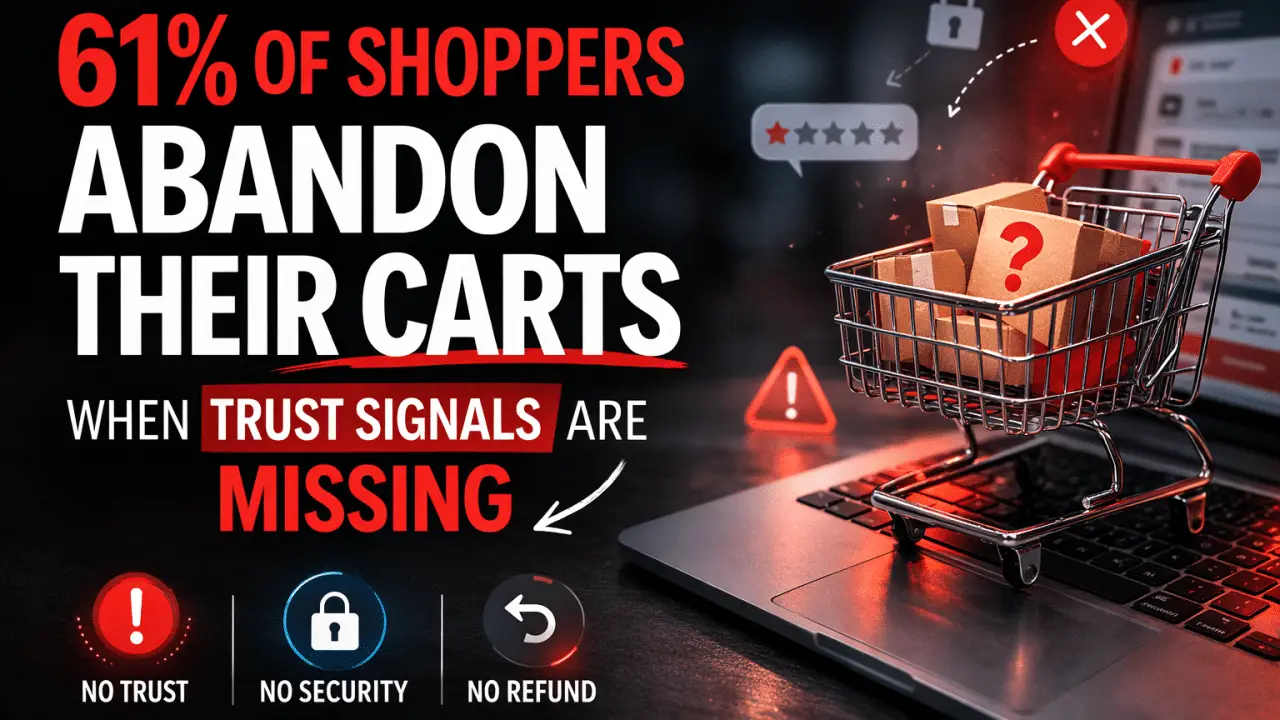
Trust is one of the biggest factors in whether a customer completes a purchase or abandons their cart. Discover how the right trust signals can increase buyer confidence, reduce cart abandonment, and improve conversion rates without changing your products or pricing.