
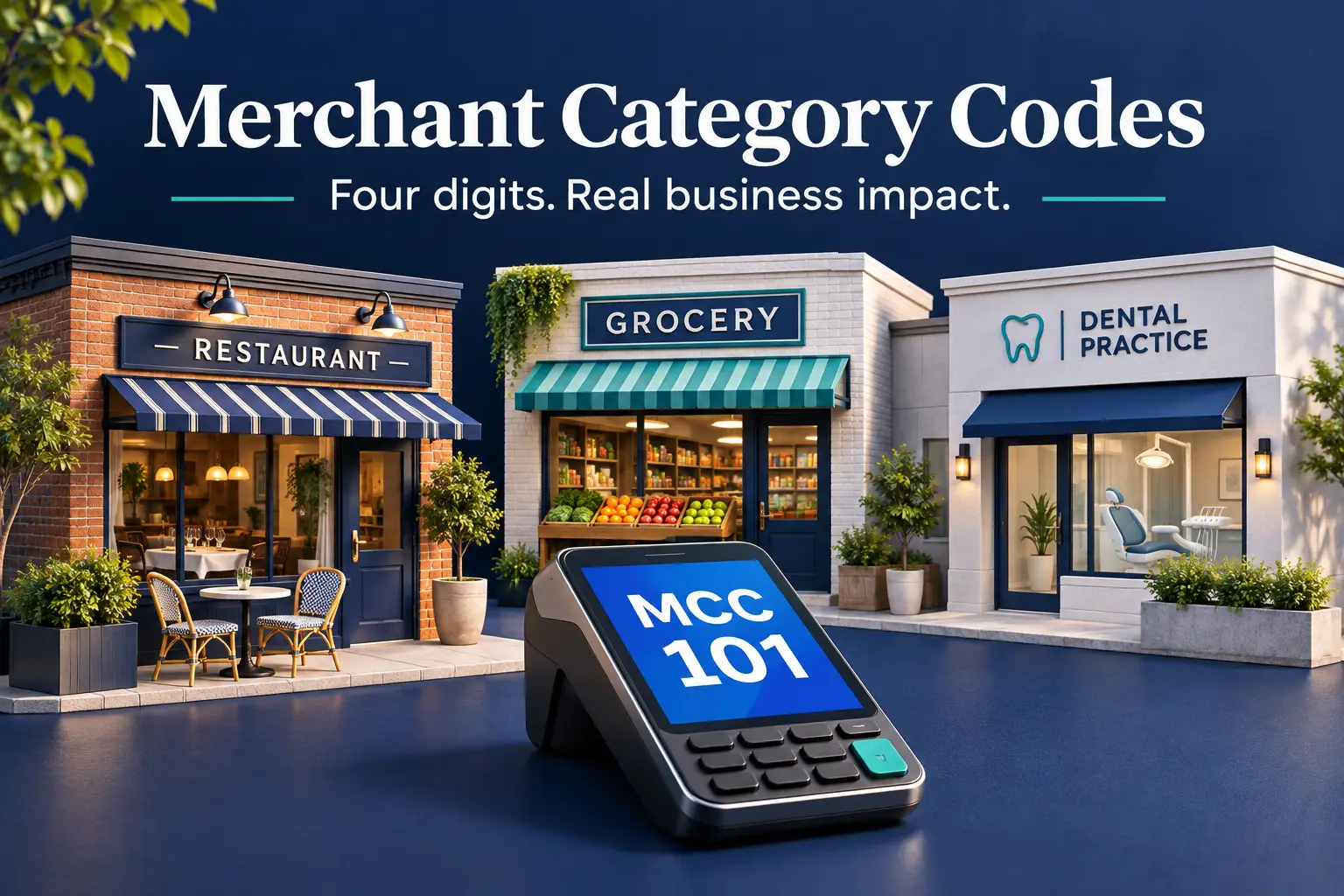
Four digits help tell the payment system what kind of business you run. Those digits can affect processing costs, how a card is handled, and whether a customer earns the rewards they expected.
They are called your Merchant Category Code, or MCC. If you accept credit or debit cards, it is worth knowing yours.
What is a Merchant Category Code?
An MCC is a four-digit classification that describes a merchant’s business activity. Your acquiring bank, the financial institution that supports your card acceptance, is responsible for the assignment under card-network rules, often working through your processor.
Visa generally bases the classification on the business activity with the highest annual sales volume. Some activities and transactions have specific requirements. Your business name alone does not determine the right code.
An MCC describes the type of business. A Merchant ID, or MID, identifies a merchant account in a processing system. Several unrelated businesses can share an MCC.
What do the codes look like?
Here are a few common examples from Mastercard’s merchant reference guide. Descriptions below are shortened for readability.
| MCC | Business category |
|---|---|
| 5411 | Grocery stores and supermarkets |
| 5812 | Restaurants and eating places |
| 0742 | Veterinary services |
| 8021 | Dentists and orthodontists |
| 8211 | Elementary and secondary schools |
These examples help explain the system. Your processor should confirm the appropriate code for your actual operation and the applicable network.
Why your MCC matters
It can affect the underlying cost of a transaction. Card networks have interchange programs with different eligibility requirements, including business category. Interchange is the fee exchanged between the acquiring and issuing banks and is one component behind the price merchants pay their provider. It is not the same as your entire processing bill.
Your card mix, how payments are accepted, and your pricing agreement also matter. A correct MCC does not guarantee a particular rate or savings. Visa’s published interchange schedule illustrates why one quoted rate cannot explain every transaction.
It helps processors assess the account. Processors use business categories as part of their risk review. They also need an accurate picture of what you sell and how you operate. When your business changes, that conversation should happen before the new activity starts running through the account.
It can affect card acceptance. Some commercial card programs allow or block purchases by merchant category. Visa’s commercial payment controls, for example, support category restrictions. If a business customer’s card is declined, the category may be one thing to investigate with the issuer and processor. It is not proof that your MCC is wrong.
It can affect customer rewards. Issuers use merchant categories when deciding which purchases qualify for bonus rewards. A customer buying food does not automatically earn a grocery or dining bonus. The merchant classification and the card’s terms matter. Chase’s rewards guidance explains this distinction.
What if your business does more than one thing?
A business may have a retail shop, a service department, and online sales. Explain each activity to your processor instead of assuming one label covers everything.
Depending on the operation and network rules, separate activities or locations may need different codes. For example, Visa requires automated fuel purchases at the pump to use MCC 5542, with other goods or services classified appropriately. Its Merchant Data Standards Manual sets out the assignment requirements.
Can you change your MCC?
You can ask your processor to review an assignment that appears inaccurate. Bring a clear description of your products or services, your website, and a breakdown of your sales. Ask what information is needed to support a correction.
The code must match the business. Choosing an unrelated category because someone says it will produce a lower rate is not an appropriate fix. Payment providers review whether a requested classification fits the operation, as explained in this processor guide to MCCs.
If a correction is approved, ask when it takes effect and how you can verify it. Do not assume it changes earlier charges or automatically produces a refund.
How to find your MCC
Start with your processor. The code may appear in your account documents or merchant portal, but it is not always easy to find on a monthly statement. Ask for the four-digit code and the description in writing.
Then ask:
- Does this code match what we sell today?
- Are all of our locations and payment channels classified appropriately?
- Does the classification affect any interchange programs available to us?
- What should we report if we add a new product or service?
Keep the answer with your processing records. Revisit it when you change providers, open another location, or make a meaningful change to your business.
Let’s review how your business is set up
You should be able to get a clear explanation of your merchant account without learning the entire payments industry.
Mosaic Processing can help you review your setup, ask the right questions about your MCC, and understand where your processing costs are coming from.
Request a free statement review. Have two or three recent processing statements available. We’ll walk through them with you and help identify what deserves a closer look.