
When a card payment goes through, or gets held, or a reserve suddenly changes, the decision almost always traces back to one party: the acquirer. Most business owners never interact with them directly, yet the acquirer is often the one making the calls that matter most.
Card processing involves a chain of companies working together, but not all of them carry the same authority. Sales organizations sign up merchants. Gateways move transaction data. Only one party in that chain actually holds the bank relationship with the card networks and takes on the financial risk of the account: the acquirer.
Understanding what an acquirer is — and what makes it different from the companies a merchant usually talks to — explains a lot about how approvals, holds, and reserves actually work.
So What Is an Acquirer?
An acquirer, sometimes called an acquiring bank or merchant bank, is the financial institution that holds the merchant agreement with the card networks (like Visa and Mastercard) and takes on the responsibility of settling funds to a business after a card transaction. The acquirer is the entity that actually underwrites the merchant, approves the account, and assumes the financial risk if something goes wrong — a chargeback, a fraud loss, a business that closes owing money on disputes.
Because the acquirer carries that risk, it’s also the party with final authority over underwriting decisions, reserve requirements, and account holds — regardless of what an ISO or sales representative may have said during onboarding.
Acquirer vs. ISO vs. Gateway
These terms get mixed up constantly, so it helps to separate the roles:
The ISO typically handles sales, onboarding, and day-to-day merchant support, operating under an agreement with an acquirer.
The gateway handles the technical transmission of transaction data between a merchant’s checkout and the broader payment system.
The acquirer is the bank that actually underwrites the account, holds the risk, and settles the funds.
A merchant can go through an ISO, use a particular gateway, and still have the same acquirer as thousands of other merchants — or a completely different one. The acquirer is the constant that determines whether an account is fundamentally stable, regardless of which other companies are involved on top of it.
Why the Acquirer’s Understanding of the Business Matters So Much
Because the acquirer is the one taking on financial risk, its understanding of what the business actually does is the single most important factor in how stable an account will be. An account underwritten by an acquirer with a clear, accurate picture of the business tends to hold up far better than one where the acquirer only has a vague or generic description on file.
This is also why two merchants can have very similar-looking accounts — same pricing, same gateway, same-looking paperwork — and still have very different outcomes if one acquirer genuinely understands the business model and the other doesn’t.
What Merchants Often Get Wrong About Acquirers
A common misconception is that the company handling customer service or sending the monthly statement is the same company making risk decisions. In many cases, that’s not true — customer service may run through an ISO, while approvals, reserve terms, and hold decisions sit entirely with the acquirer behind the scenes.
Another common misunderstanding is assuming that a “backup” merchant account provides real protection, when in fact it shares the same acquirer as the primary account. If the acquirer is the point of failure, a second MID processed through the same bank doesn’t add meaningful redundancy.
Questions Worth Asking
Who is the acquiring bank behind this account, not just the ISO or processor brand name?
Does that acquirer actually know the specifics of the business, or just a general category?
If a backup account exists, does it use a different, independent acquirer?
The Main Takeaway
The acquirer is the party that ultimately decides whether a business gets approved, what terms apply, and what happens if the account comes under review. Sales organizations and gateways matter for service and technology, but the acquirer is where the real underwriting authority and financial risk sit. Knowing who that is — and how well they understand the business — is one of the clearest indicators of how durable a merchant account actually is.
Want to know which acquiring bank is actually behind your current processing setup? Mosaic Processing can help you find out.
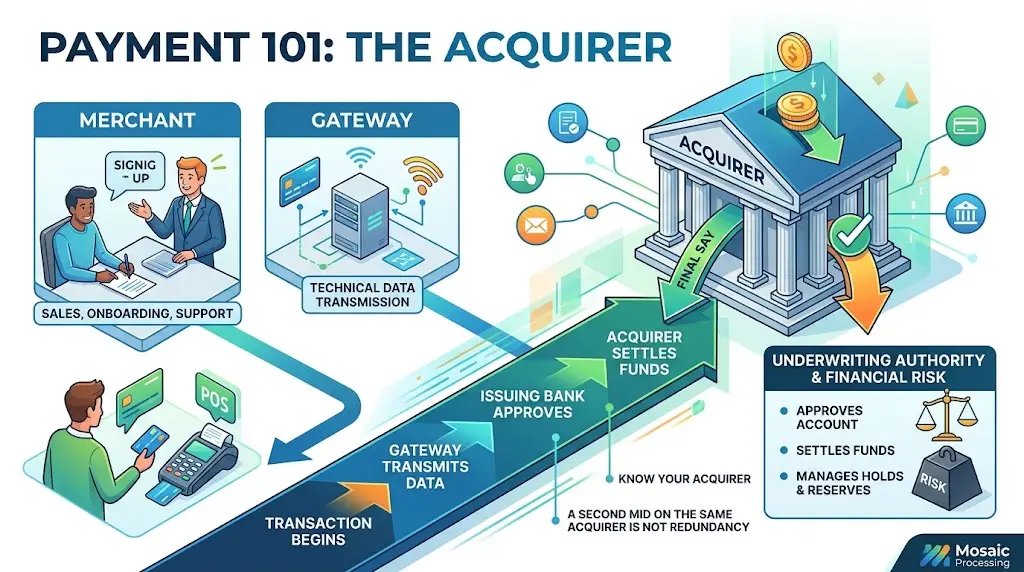
The acquirer is the financial institution with final authority over merchant underwriting, reserves, account holds, and settlement. Learn how an acquirer differs from an ISO or gateway—and why knowing the bank behind your processing relationship is critical to account stability.